
Description
AEO Ultimate prepares your WordPress site for the AI-first web. As search shifts from ten blue links to AI-generated answers, the signals that get your content cited — structured schema, author authority, publisher identity, and machine-readable content — matter more than ever.
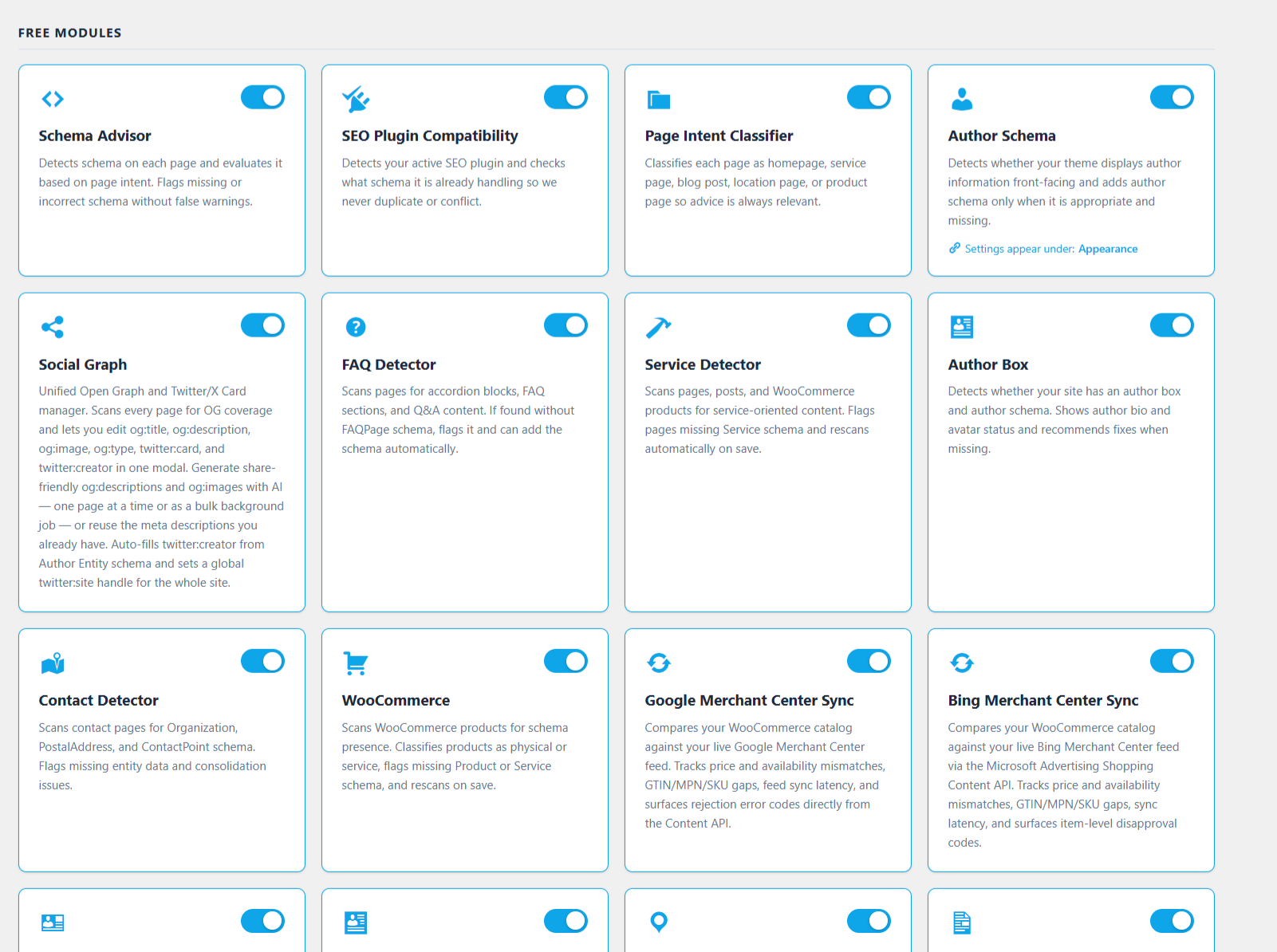
Fully modular: enable only what your site needs. Every feature toggles independently.
🔍 Schema Markup & Structured Data
The core engine. It detects the schema already on each page, classifies page intent (homepage, service page, blog post, location page, or product), and outputs clean JSON-LD only where it’s missing — never duplicating what your SEO plugin already provides. Structured data includes Organization, Article, NewsArticle, Person (author), FAQPage, Service, Product (with Brand and Offer), LocalBusiness, ContactPoint, Event, Review, AggregateRating, and BreadcrumbList. The Command Center gives you a live readiness score, duplicate-schema conflict alerts, and real-time AI-crawler activity. When a page carries more than one schema type, they’re automatically woven into a single connected @graph — one identity spine (WebSite Organization WebPage) with every entity cross-referenced by @id — so AI crawlers read your site as one web of facts instead of scattered fragments.
🤖 AI Ready: llms.txt & Crawler Control
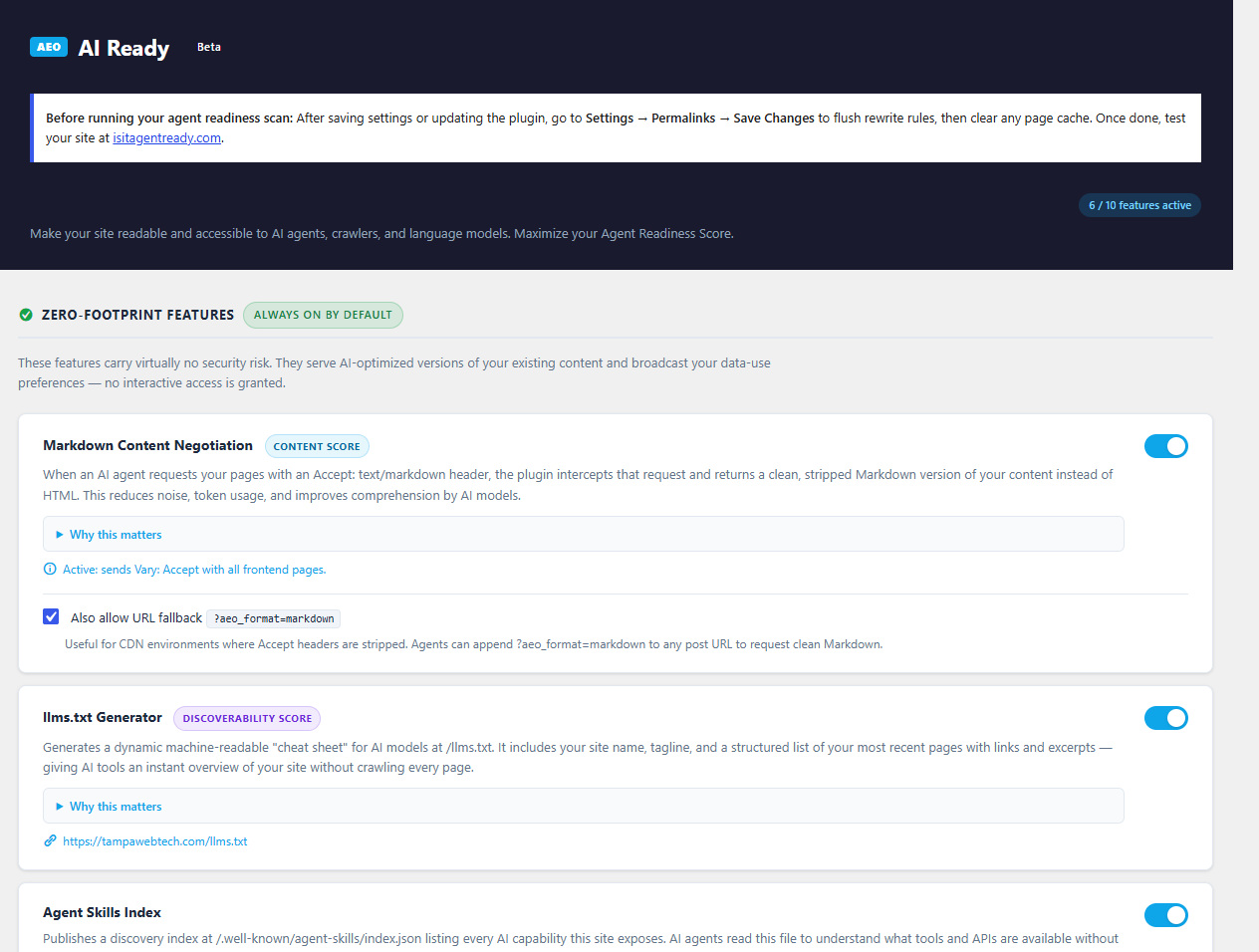
llms.txt and `llms-full.txt` endpoints, Markdown content negotiation for AI agents, Content-Signal headers, semantic Breadcrumb signals, RFC 8288 Link headers for agent discovery, an Agent Skills Index (`/.well-known/agent-skills/`), an Agent Search REST API, MCP/WebMCP discovery, OAuth/OIDC discovery, an RFC 9727 API catalog, and per-bot rate limiting and blocking for 20+ AI crawlers (GPTBot, ClaudeBot, PerplexityBot, Google-Extended, and more). The plugin can create the `/.well-known/` agent-discovery files for you so your site reads as "agent ready" — verify it with a checker like isitagentready.com. Automatic setup needs server write access; where that's unavailable, you get copy-and-paste instructions to add the files by hand. You decide exactly which AI systems may read, cite, or train on your content.
🏢 Company & Publisher Identity
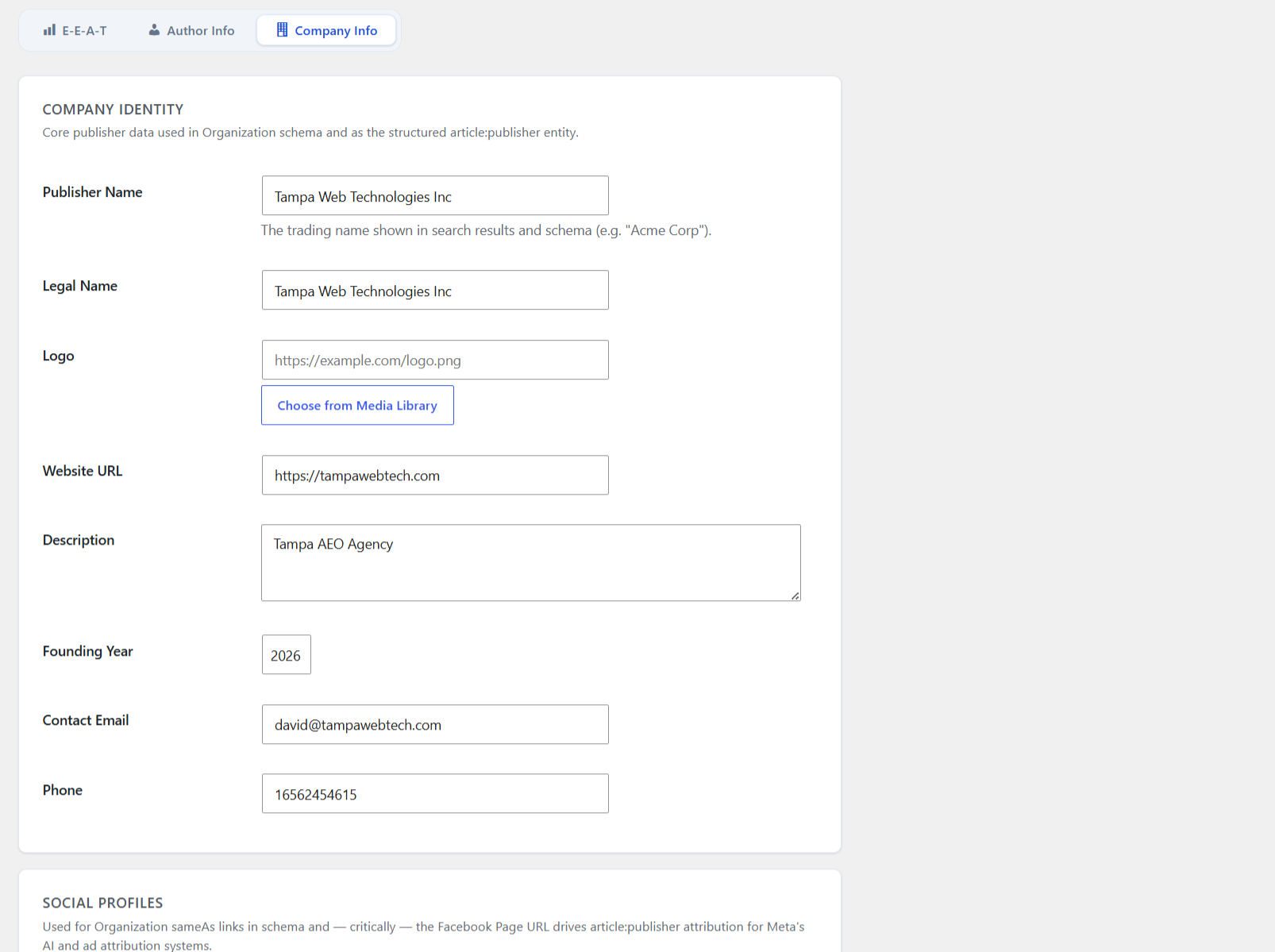
Organization JSON-LD (legal name, logo, contact points, sameAs), an explicit article:publisher / article:author Open Graph split, a sitewide fb:app_id for Meta Domain Insights, and one-click import from Yoast or Rank Math.
✍️ Author & Company E-E-A-T
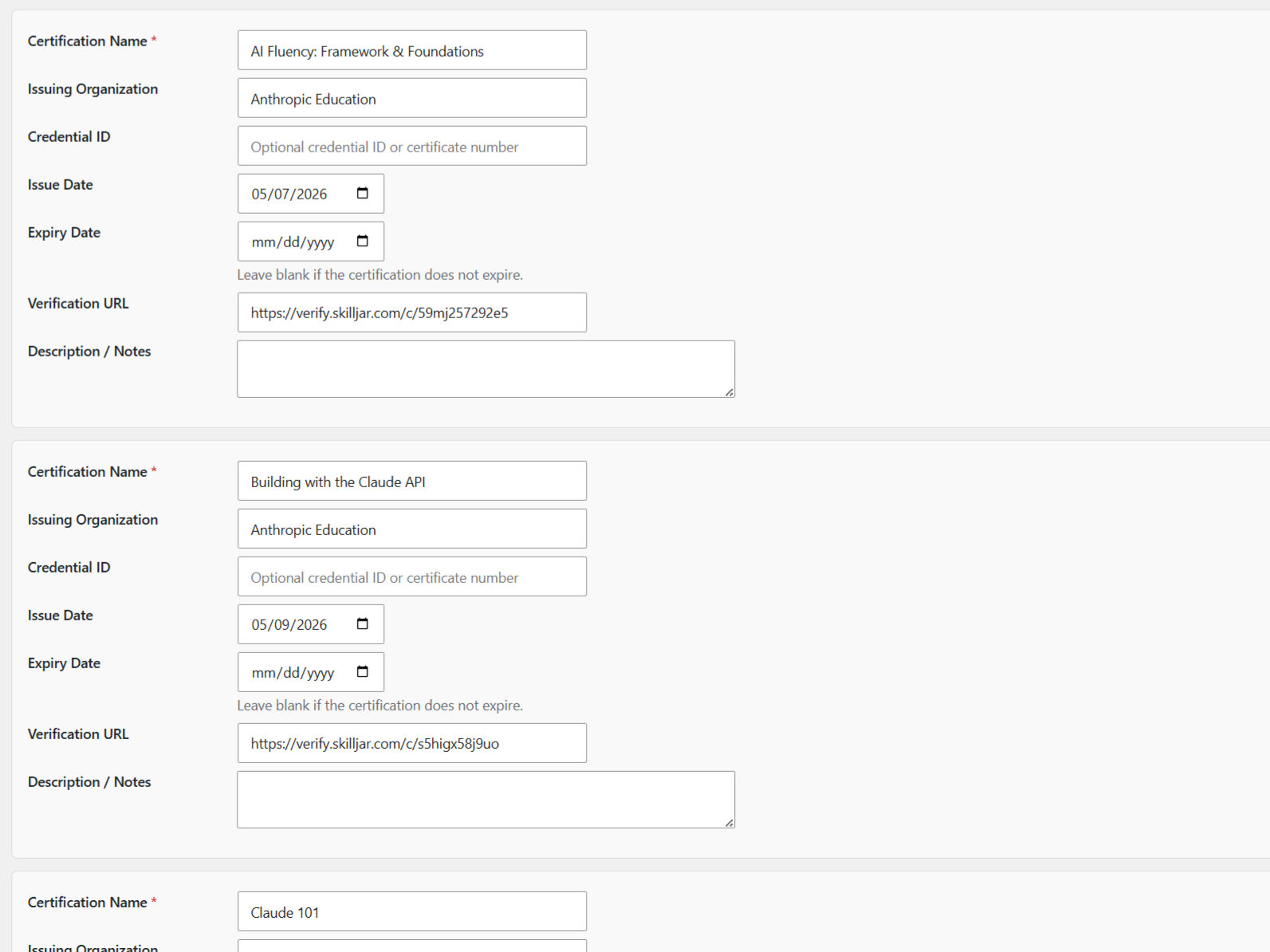
An E-E-A-T scorecard for both your author and company (publisher) entities. Author profiles output as Person schema with EducationalOccupationalCredential and sameAs — job titles, credentials, expertise areas, years of experience, and social links — alongside your organization details. The plugin suggests the missing trust items and applies them semi-automatically. Includes optional author boxes and hover cards, plus a completeness score across every author.
🖼️ Image SEO & Open Graph
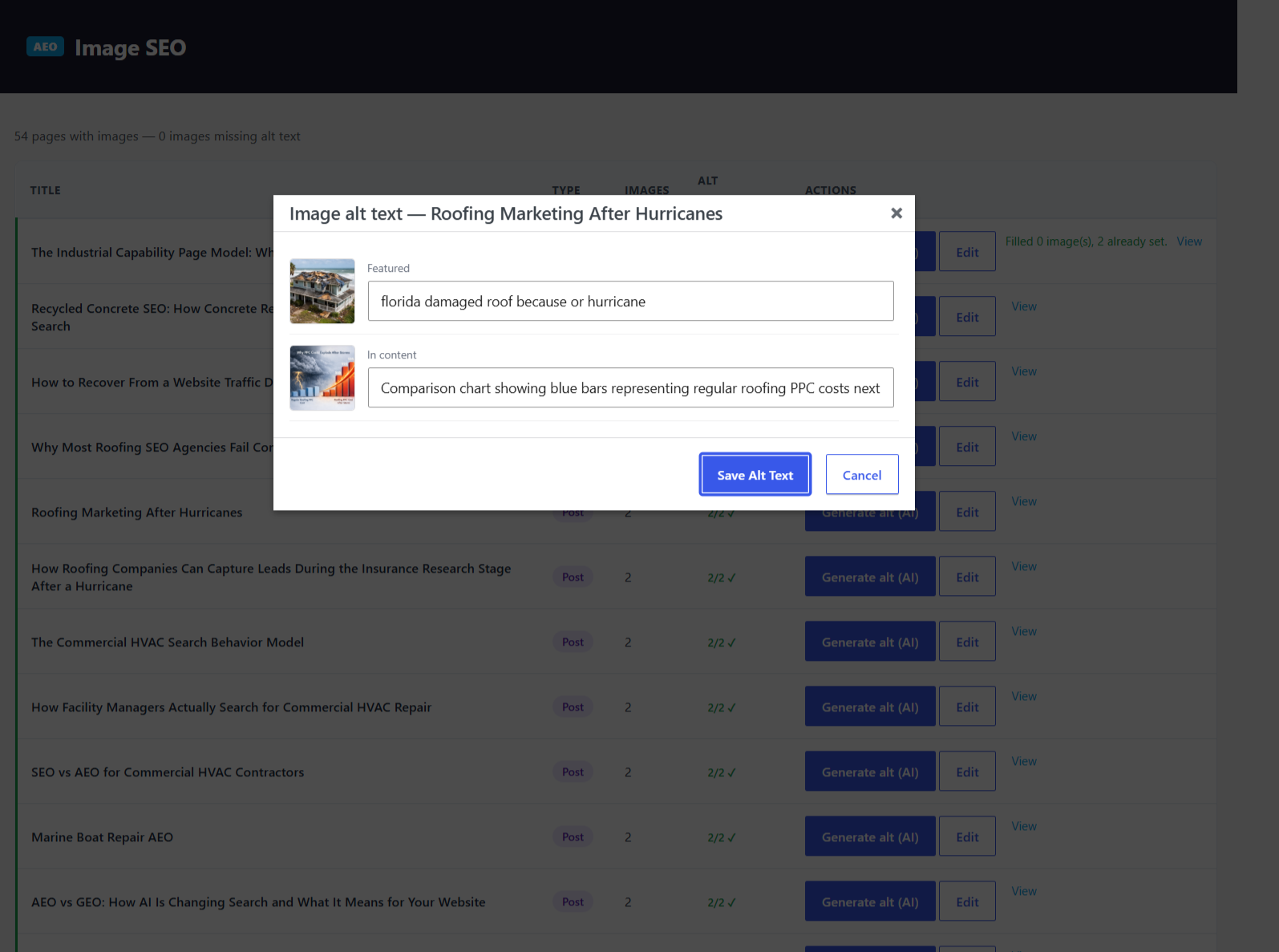
Generate image alt text and Open Graph titles, descriptions, and share images — automatically from your content or with AI. A unified Open Graph and Twitter/X Card manager scans every page for coverage and lets you edit og:title, og:description, og:image, og:type, twitter:card, and twitter:creator from one screen.
🛒 WooCommerce & Shopping
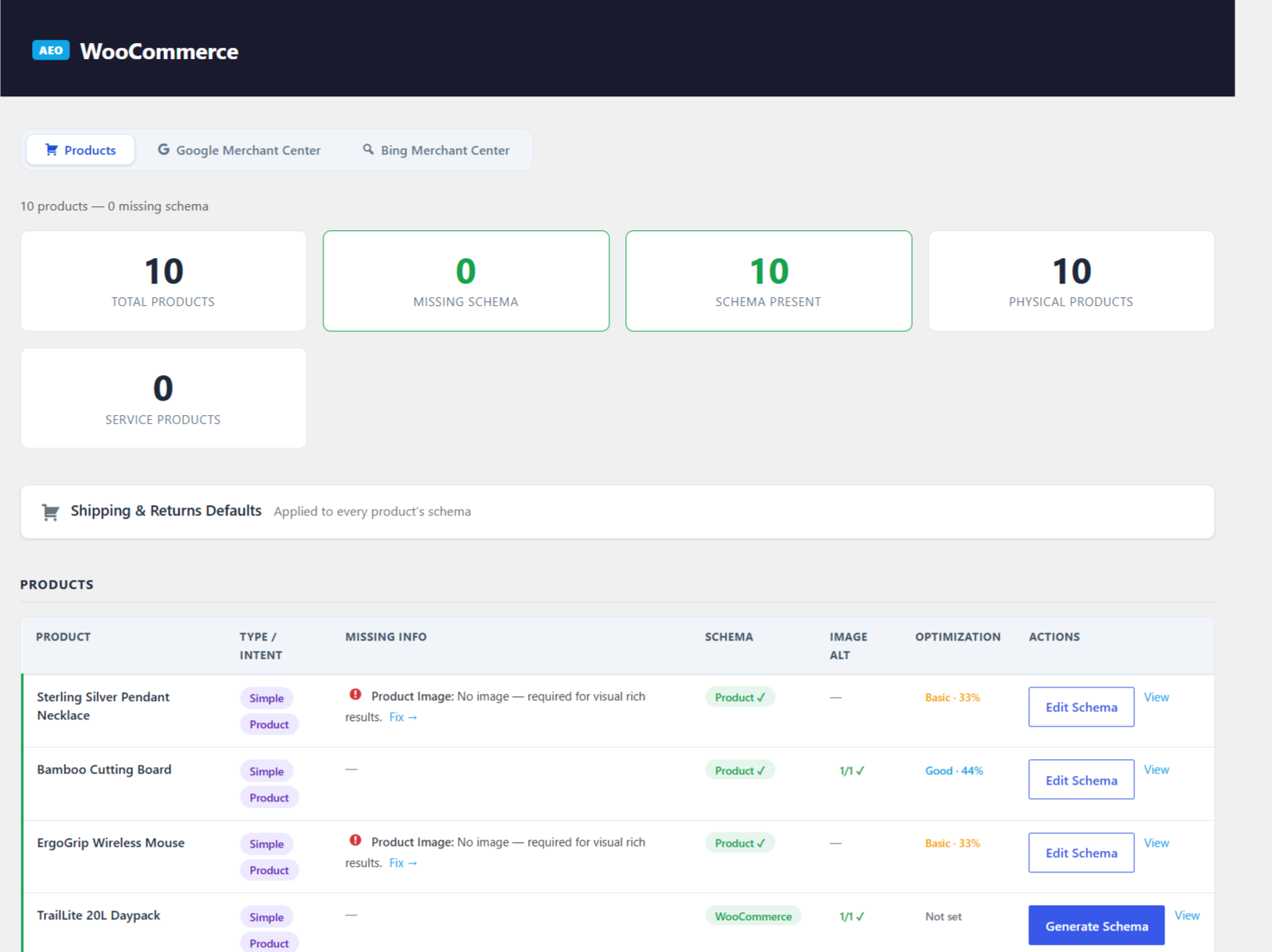
Automatic Product schema built from your product attributes (Brand, Offer, price, availability, GTIN/MPN/SKU), optional AI product-description enrichment, and live sync against your Google Merchant Center and Bing Merchant Center feeds — tracking price and availability mismatches, identifier gaps, and item-level rejection codes.
📍 Local SEO
Build LocalBusiness schema with a predictive business-type picker, opening hours, service area, and geo coordinates. Audit NAP (name, address, phone) consistency against Google Knowledge Graph, Google Business Profile, and Bing Maps — and get a list of the directories and citation sites you should be listed on, tailored to your industry.
🗺️ Sitemaps, Indexing & News
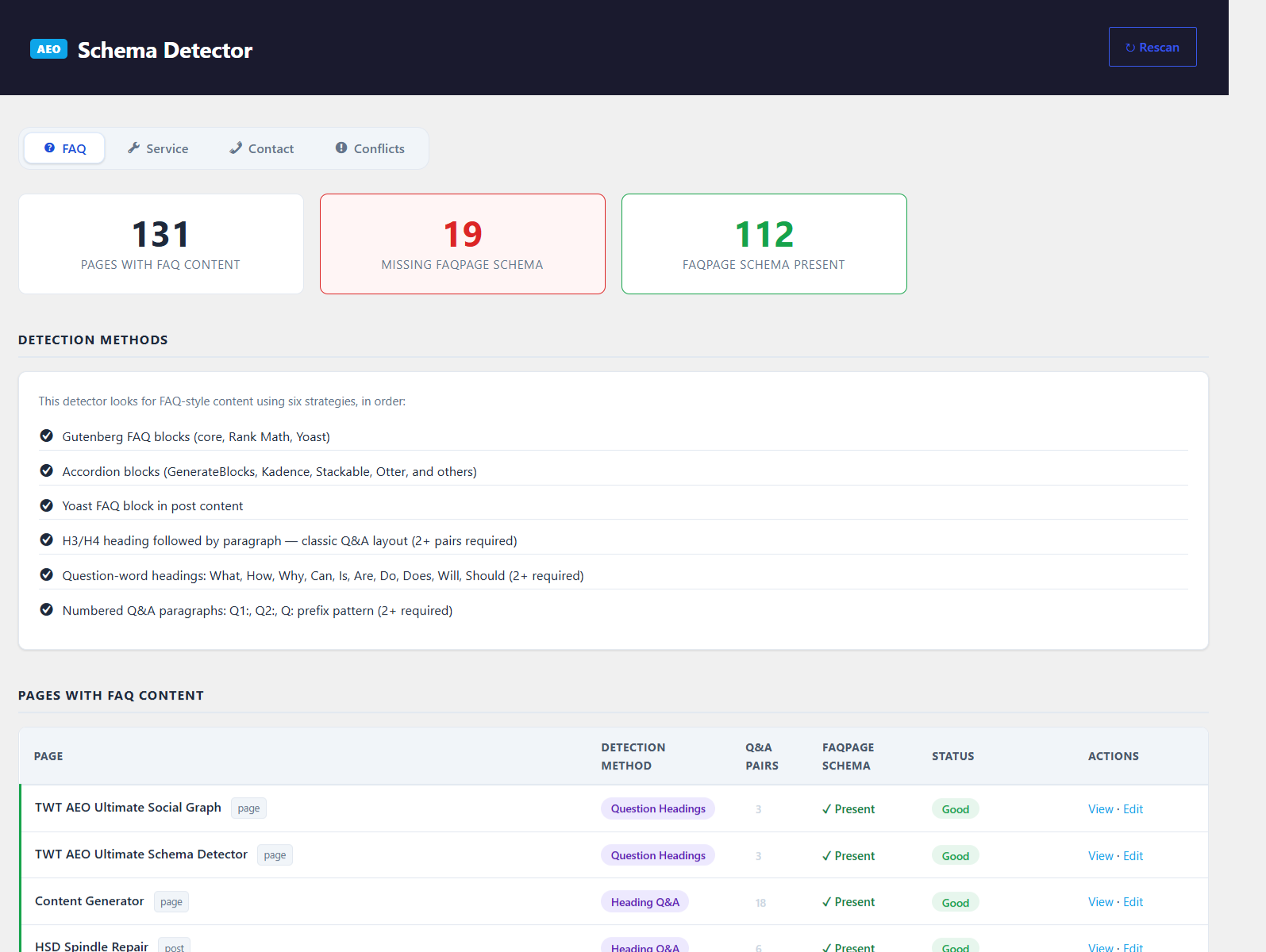
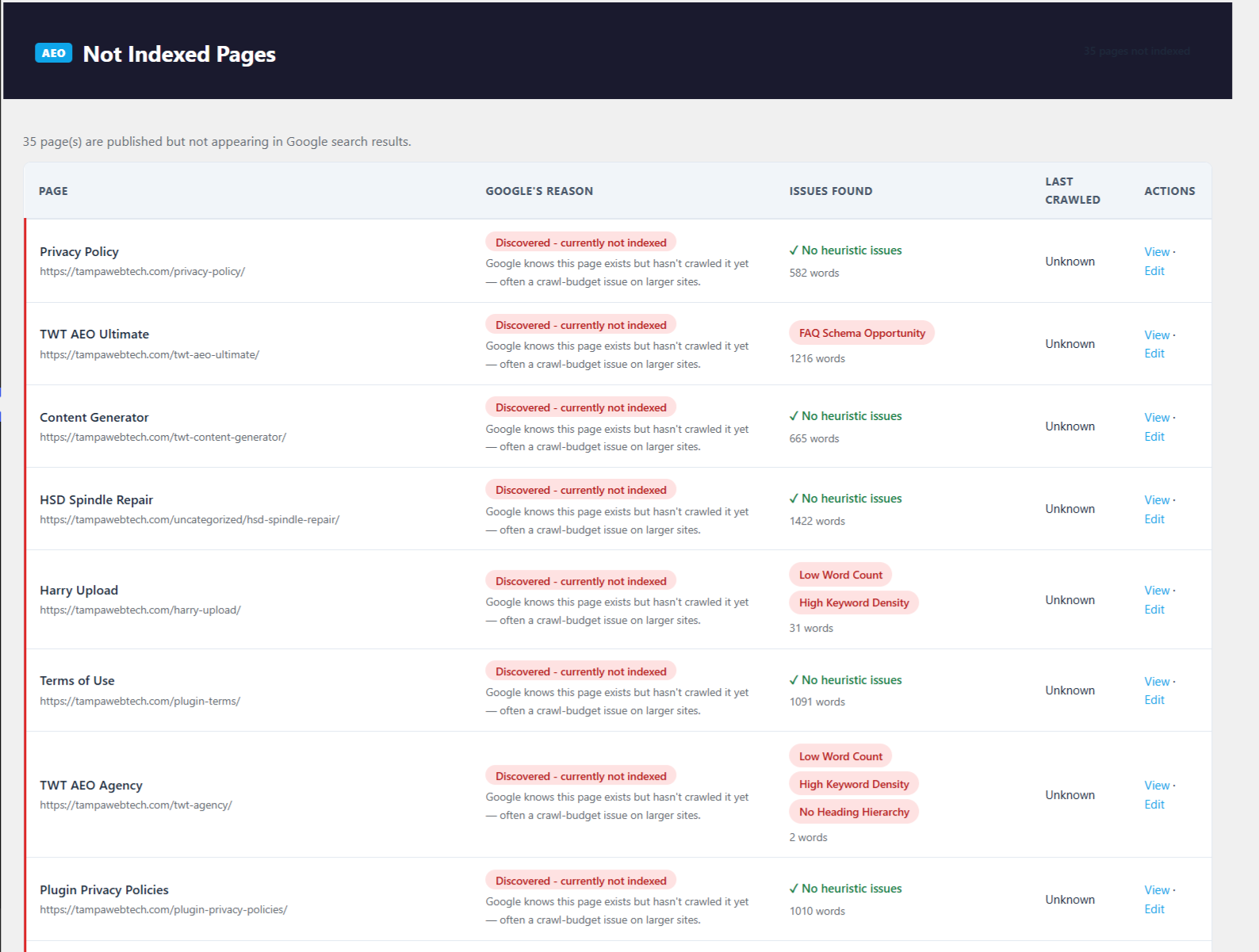
A cached XML sitemap at /aeo-sitemap.xml with per-post-type controls and collision protection against Yoast, Rank Math, and AIOSEO. IndexNow instantly pings Bing, Yandex, and other engines on publish. A Google News sitemap with NewsArticle schema kicks in when your content qualifies as news. And a Not Indexed report uses the Google Search Console URL Inspection API to find pages that are published but missing from Google’s index, then flags likely causes — thin content, keyword stuffing, missing heading hierarchy — so you know what to update.
📊 Command Center: Analytics & Performance
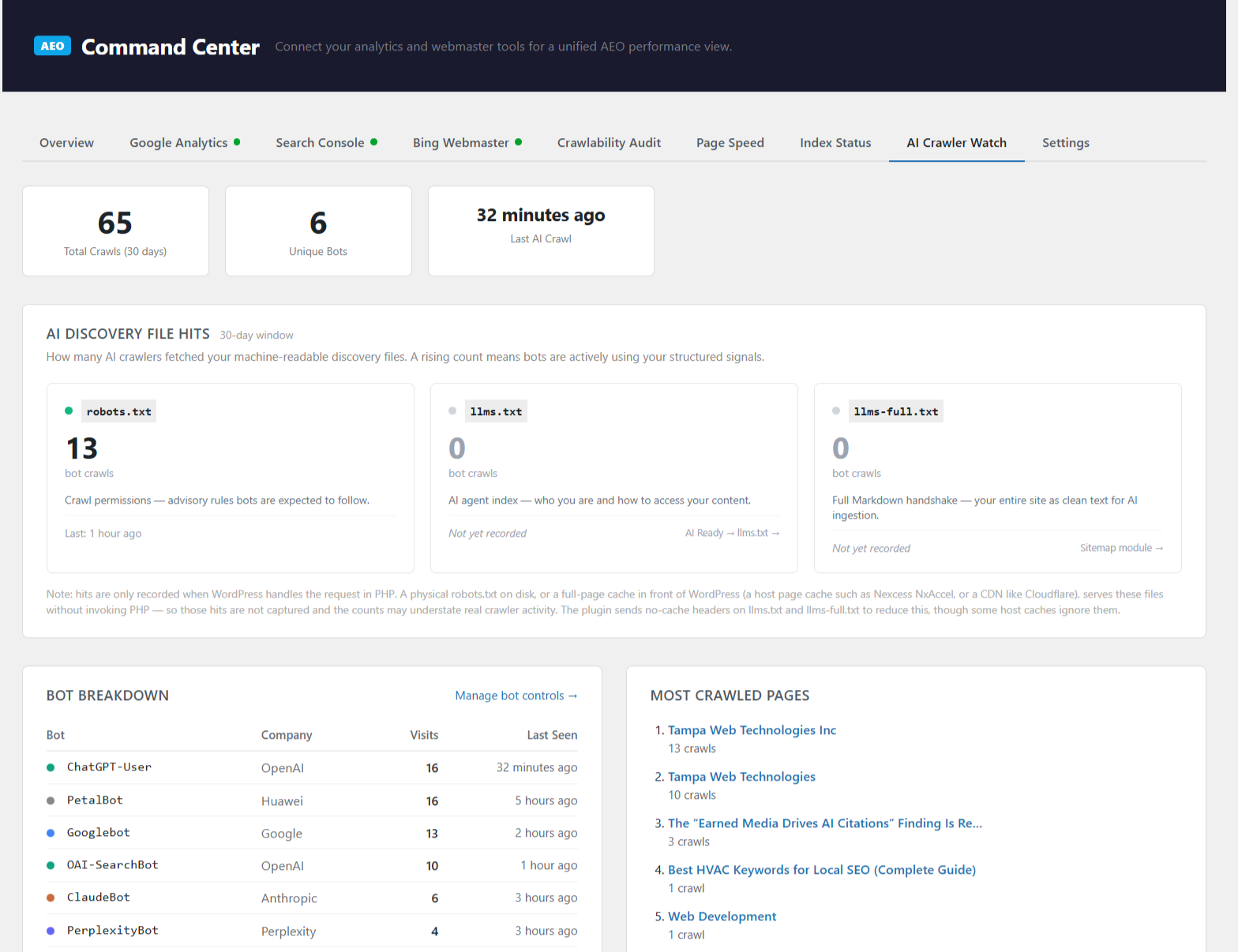
Connect Google Search Console, Google Analytics 4, and Bing Webmaster Tools for a single AEO performance view. Run Google PageSpeed Insights audits — the Lighthouse score plus the Core Web Vitals (LCP, CLS, FCP, TBT) that affect both ranking and how cleanly AI crawlers render your pages, cached for six hours. A traffic-leak scan cross-references GA4 (last 28 days) with PageSpeed to surface your highest-traffic pages that also bounce hard on slow mobile loads, and a content scan flags on-page anti-patterns — inline scripts, external scripts in content, base64 images, and iframes — that page builders and AI-pasted code often introduce. When Google and Bing surface their AI search reports (AI Mode and AI Overviews), the Command Center links you straight to them.
🛠️ More Tools
Customer Reviews with context-aware AggregateRating/Review schema, display shortcodes, and industry-based suggestions for where to collect more reviews. A “Last Updated” freshness badge. PR Bridge AI, which detects press-release intent in your posts and offers ways to distribute them. And an AI Prompt Rate Limiter to protect your API budget.
External Services & TWT Agency
Optional AI features connect to Anthropic Claude, OpenAI, Google Gemini, and Perplexity using your own API keys. Other optional integrations cover Google and Microsoft APIs, IndexNow, and PR wire services. Nothing is sent anywhere until you configure a feature and explicitly trigger it — see the FAQ for the full list with terms and privacy links, and the bundled EXTERNAL-SERVICES.md for the complete outbound-link inventory. Optional TWT Agency connectivity is available; the plugin is fully functional standalone.
Screenshots
Installation
Automatic installation (recommended)
- In your WordPress dashboard, go to Plugins Add New Plugin.
- Search for TWT AEO Ultimate.
- Click Install Now, then Activate once installation finishes.
You can also install from a downloaded ZIP: on the Plugins Add New Plugin screen, click Upload Plugin, choose the twt-aeo-ultimate.zip file, then Install Now and Activate.
Manual installation (FTP)
- Upload the entire
twt-aeo-ultimatefolder to your/wp-content/plugins/directory. - Activate the plugin via the Plugins screen in your WordPress dashboard.
After activating
- Go to TWT AEO Modules to review and enable the features you want.
- Set up your publisher identity under TWT AEO E-E-A-T (the Company tab).
- Complete each author’s E-E-A-T data on their profile under Users All Users.
- Configure bot visibility and access controls at TWT AEO AI Ready.
Important: After activating, go to Settings Permalinks and click Save Changes once. This flushes rewrite rules so the virtual routes for /llms.txt, /llms-full.txt, and /aeo-sitemap.xml resolve correctly.
FAQ
-
Which schema types (structured data) does this plugin generate?
-
JSON-LD for Organization, Article, NewsArticle, Person/author (with EducationalOccupationalCredential and sameAs), FAQPage, Service, Product (with Brand and Offer), LocalBusiness (with opening hours and geo coordinates), ContactPoint, Event, Review and AggregateRating, and BreadcrumbList. Each type is added only when it suits the page and isn’t already present.
-
Does it support llms.txt and AI search engines like ChatGPT and Perplexity?
-
Yes. It serves
/llms.txtand/llms-full.txt, offers Markdown content negotiation for AI agents, sends Content-Signal headers, and gives you per-bot rate limiting and blocking for 20+ AI crawlers — the signals that help ChatGPT, Claude, Perplexity, and Google AI Overviews discover and cite your content. -
Does this plugin conflict with Yoast SEO or Rank Math?
-
No. AEO Ultimate detects active SEO suites and steps back from any metadata they already output (Organization, Article, Open Graph). It acts as an enhancement layer, adding the signals those suites typically miss —
article:publisher, rate-limit controls for 20+ AI agents, author credential schema, andllms.txtprocessing. -
What is llms.txt and why do I need it?
-
llms.txt is an emerging standard (see llmstxt.org) that gives AI systems a clean, machine-readable summary of what your site contains and how to access it. Think of it as a
robots.txtwritten for language models. The companion endpoint/llms-full.txtserves your content as clean Markdown so crawlers can ingest it without parsing token-heavy HTML. -
Standard social tags often blur authorship by failing to separate your brand from the individual writer. AEO Ultimate keeps them distinct:
article:publisherestablishes the company identity, whilearticle:authorlinks to the individual author. AI models use this split to assess authority and attribute content accurately. -
What does the Meta Business Sync do?
-
It adds the sitewide
fb:app_idtag, which links your domain to your Meta Developer App. That unlocks the Meta Domain Insights dashboard and helps Meta attribute your content correctly across its ad and AI systems. Most SEO plugins don’t output this tag. -
Can I block specific AI bots or engines safely?
-
Yes. Under TWT AEO AI Ready Security & Rate Limiting, each of 20+ known AI crawlers has a Block toggle and a custom rate-limit override. Blocking a bot writes a
Disallowentry to your virtualrobots.txtand returns a 403 on its requests — both advisory and hard enforcement. -
Will the rate limiter affect my human visitors?
-
No. The filter matches requests by User-Agent against the known AI crawler list only. Regular browsers, ordinary visitors, and traditional search engines (like Googlebot) pass through unaffected.
-
Will this add overhead or slow down my site?
-
No. Frontend metadata, schema, and virtual assets are served from the WordPress Transients API with a 1-hour cache. Heavier work runs only when a post is saved or settings change. The crawler rate limiter adds a single transient read per page load, and only for known AI agents.
-
Does it monitor site performance and analytics?
-
Yes. The Command Center connects Google Search Console, Google Analytics 4, and Bing Webmaster Tools in one view, and runs Google PageSpeed Insights audits (the Lighthouse score plus Core Web Vitals — LCP, CLS, FCP, TBT), cached for six hours. A traffic-leak scan combines GA4 and PageSpeed to surface high-traffic pages that bounce hard on slow mobile loads, and a content scan flags performance anti-patterns like inline scripts and base64 images. Everything is optional and stays off until you connect the relevant service with your own credentials.
-
Which AI agent-discovery standards does it support?
-
It can serve an Agent Skills Index (
/.well-known/agent-skills/), an MCP server card and WebMCP context injection, OAuth/OIDC discovery, an RFC 9727 API catalog, RFC 8288 Link headers, Content-Signal headers, and semantic Breadcrumb signals — alongsidellms.txt,llms-full.txt, and Markdown content negotiation. Each endpoint toggles independently, and where automatic/.well-known/file creation needs server write access you’ll get copy-and-paste instructions instead. -
What are the system requirements?
-
PHP 7.4 or higher (PHP 8.0+ recommended) and WordPress 6.2+. For full functionality on WordPress 7.0 and its modern data views, MySQL 8.0 and a PHP memory limit of at least 256MB are recommended.
-
What external services does this plugin connect to?
-
Only the ones you configure, and only when you trigger them:
- Anthropic Claude — AI writing and enrichment. Terms | Privacy
- OpenAI — descriptions, OG images, image analysis. Terms | Privacy
- Google Gemini — descriptions, vision, grounded lookups. Terms | Privacy
- Perplexity — brand authority and gap research. Terms | Privacy
- Google APIs — Search Console, Analytics, Knowledge Graph, Business Profile, Merchant Center. Terms | Privacy
- Microsoft / Bing APIs — Webmaster Tools, Merchant Center, Maps Local Search. Terms | Privacy
- IndexNow — URL submission on publish. Terms & Privacy
- EIN Presswire — press-release distribution. Terms | Privacy
- EasyPRwire — press-release distribution. Terms | Privacy
- TWT Agency (optional) and opt-in token telemetry. Terms | Privacy
Each request sends only the data needed for that action, using your own API key. No site-visitor personal data is ever transmitted. The plugin also displays outbound links to industry directories and documentation sites — no data is sent to those; the complete inventory with each site’s terms and privacy policy ships in EXTERNAL-SERVICES.md inside the plugin folder.
Reviews
There are no reviews for this plugin.
Contributors & Developers
“TWT AEO Ultimate” is open source software. The following people have contributed to this plugin.
Contributors
Translate “TWT AEO Ultimate” into your language.
Interested in development?
Browse the code, check out the SVN repository, or subscribe to the development log by RSS.
Changelog
2.11.0
- New unified Knowledge Graph: when a page would output two or more schema blocks (for example Organization + FAQPage, or a post with an author), they are now woven into a single connected
@graph— one identity spine (WebSite Organization WebPage) with every entity cross-referenced by@id— instead of separate, disconnected JSON-LD blocks. Pages with only one schema type are left exactly as before. - Consolidates duplicate Organization output, links each page’s primary entity (Article, FAQPage, Service, Product) to the WebPage, and emits the author (Person) and publisher (Organization) once, referenced by
@id. - New Knowledge Graph admin page to define entities, relationships, and per-URL about/mentions mappings, with Wikipedia/Wikidata
sameAsgrounding.
2.10.0
- New Smart 404 Rescue module (default off): turns 404s into fixes with no per-404 logging. Ignores hacker/bot probes, matches dead URLs to the closest page by typo-distance, auto-heals broken internal links at the source (with undo), and 302s visitors on.
- Smart 404 Lost Page Recovery uses your existing Search Console connection to find pages Google still ranks that now 404 (renamed/moved content), and auto-creates permanent 301s to the closest live page — applying to crawlers too, so equity transfers. Ambiguous matches are listed for one-click approval; a GSC 404 export can also be pasted in.
- Smart 404 admin page to run the lost-page scan, approve redirects, review/remove 301s, undo heals, and extend the hostile-probe patterns.
2.9.1
- Product schema now emits Google’s newly documented merchant-listing fields:
priceValidUntilon every offer,validFrom/validThroughfor scheduled sales (simple and variable products), and the recommendedcategoryproperty mirrored from WooCommerce product categories. - New AI Google Product Category resolver: one click maps a product to Google’s official Product Taxonomy and adds it to the schema as a
CategoryCodeobject, so Google Shopping and AI shopping agents read the same category. Cached per product. - Category alignment audit: Google and Bing Merchant Center sync now flags products whose on-page category disagrees with the feed, as a new Category Mismatch signal in the Integrity Score.
2.9.0
Initial public release on WordPress.org.
- Schema Advisor and Detector — Organization, Article, NewsArticle, Person, FAQPage, Service, Product, LocalBusiness, ContactPoint, Event, Review, AggregateRating, and BreadcrumbList JSON-LD, added only where missing.
- AI Ready —
llms.txtandllms-full.txt, Markdown content negotiation, Content-Signal headers, and per-bot rate limiting and blocking for 20+ AI crawlers. - Author E-E-A-T profiles and Company/publisher identity (
article:publisher,fb:app_id). - Open Graph and Twitter/X Card manager with optional AI-generated share images.
- WooCommerce Product schema with Google and Bing Merchant Center sync.
- Local SEO with LocalBusiness schema and NAP consistency auditing.
- XML and Google News sitemaps, IndexNow, Image SEO alt text, Reviews, and a Not Indexed scanner.